
In May 2025, a new chapter began in the history of the Pharmaflight Aviation Academy in Debrecen when the first Indian pilot trainees arrived for the institution’s integrated EASA CPL training program. Almost a year has passed since then, and we asked Zoltán Sajtos, the international training director at the Pharmaflight Aviation Academy, about his experiences so far.
– Where did the idea come from for the academy to launch a commercial pilot training course for Indian applicants?
– Gyula Győri, chairman of Pharmaflight’s board of directors, pointed out in 2024 that India is experiencing explosive growth in air travel, as the country’s two largest airlines have ordered more than a thousand new aircraft, and India will need approximately twenty thousand new pilots to operate them in the coming years. Pharmaflight Aviation Academy has gained significant experience over the past few years, as it operates as an affiliated aviation engineer department of the Faculty of Engineering at the University of Debrecen. To date, more than two hundred students have graduated from the University of Debrecen’s Faculty of Aeronautical Engineering, who, in addition to their B.S. degrees, have obtained a Commercial Pilot License (CPL) approved by the European Union Aviation Safety Agency (EASA) and a type rating for the Airbus A320 aircraft under the auspices of the Pharmaflight Aviation Academy. Over the past eight years, applicants from more than forty countries have come to Debrecen for professional pilot training, enabling the Pharmaflight Aviation Academy to prepare for the arrival of Indian pilot candidates. This was followed by a major marketing effort in India, during which we sought out local professional partners through whom the admissions process was launched. As a result, the first students arrived last May.
– Through which Indian partners can interested young people from India come to Debrecen?
– There are several pilot training organizations in India that provide theoretical training for applicants approved by the local aviation authority, the DGCA. In addition, numerous flight schools offer courses, but local training organizations can only meet the sudden surge in interest to a limited extent. That is why they are seeking partners abroad, including in the United States, South Africa, Australia, and now in Europe through Pharmaflight Aviation Academy. I am proud to say that our training organization is a pioneer in the Indian market, where previously students were sent primarily to the United States for FAA training, but India has also realized that the commercial pilot license issued by EASA is currently the most valuable in the industry, as it is accepted by more than seventy airlines in over forty countries worldwide. Thanks to this, and to a media campaign launched in collaboration with local partners, an increasing number of young Indians have decided to pursue an EASA CPL and complete the required training in Debrecen.
– What requirements must applicants meet?
– The basic admission requirements are a valid aeromedical certificate, high school graduation exam scores at the required level in mathematics and physics, and a valid passport for travel. Successful applicants will then receive a Hungarian and EU temporary residence permit valid for 18 months, following review and approval by the Migration Office of the Hungarian Ministry of the Interior, which allows them to enter Hungary and begin their flight training.
– Where are the students who started in Debrecen last June now?
– All of them have already completed the theoretical training, which is based on the ATP (Air Transport Pilot) curriculum; that is, students in the EASA CPL course study the ATP theoretical subjects across a total of thirteen topics and take exams before their 18-month full training program concludes. In addition, starting in the third month, their practical training begins on the academy’s Tecnam P2008JC single-engine glass-cockpit training aircraft. On these, they first fly with an instructor and performing training patterns and cross country flights; later, when their instrument flight training begins, they switch to the twin-engine Tecnam 2006P, which also features a glass cockpit. Several students in the first group are already at this stage.
– How many aircraft are there in the Pharmaflight Aviation Academy’s fleet?
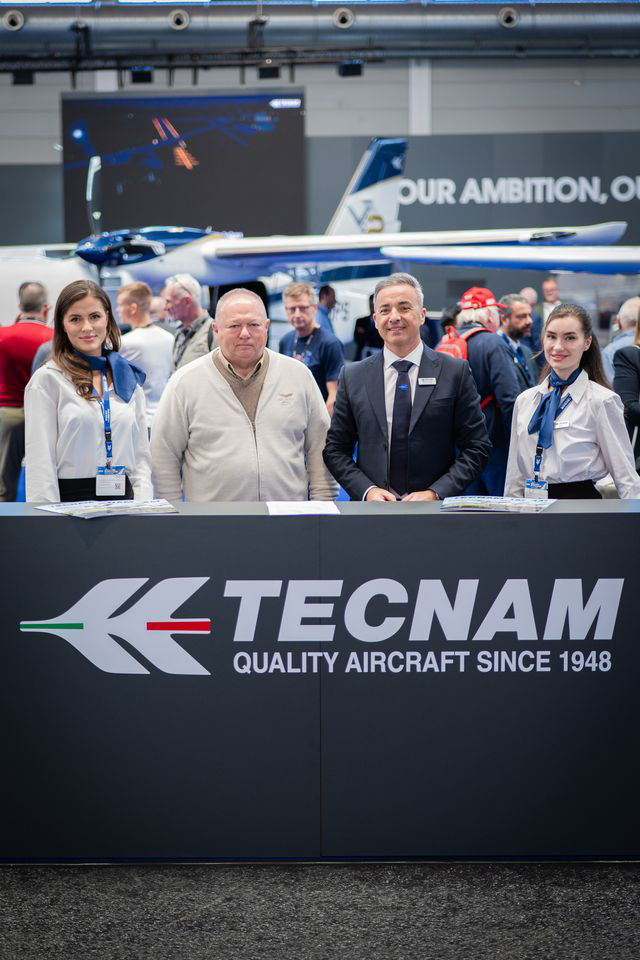
– Currently, three single-engine Tecnam P2008JCs and three twin-engine Tecnam 2006Ps are available to the students, but we just returned from the Aero Expo 2026 exhibition in Friedrichshafen, Germany, where we held advanced negotiations with the Italian manufacturer Tecnam regarding the purchase of three additional Tecnam P2008JC NG next-generation training aircraft. With this, we plan to increase the number of aircraft in the Tecnam fleet to nine by the end of the year. However, the current fleet is sufficient for training Indian pilot candidates, as we maintain the aircraft under a Continuous Airworthiness Management Organization (CAMO) and perform the necessary maintenance tasks on them. To ensure this runs smoothly, we maintain constant communication not only with our maintenance organizations (MRO) but also with the aircraft manufacturer Tecnam and the engine manufacturer Rotax. With this fleet, we can seamlessly provide training for more than 100 students annually. In addition, other aircraft can be used if necessary.
– How many Indian students are currently enrolled at the Pharmaflight Academy?
– Following the first group that arrived last May, additional students from India arrived in November and January, and now a new group—the fourth—is set to arrive in May. This means that nearly fifty students are participating in the training. Most applicants have already completed the DGCA ground school course offered by our partner Indian academies back home, so they arrive in Debrecen with a solid foundation of theoretical knowledge. Most of the Indian applicants will remain in Hungary for a while after obtaining their EASA CPL to accumulate the required flight hours in accordance with the commercial pilot license requirements set by the Indian authorities; there are also those who have enrolled in the flight instructor course to gain even more flight experience—whether at the Pharmaflight Academy or at another flight school, before applying to become a commercial pilot with an airline.
– Why should Indian and other international applicants apply to the Pharmaflight Aviation Academy in Debrecen if they want to become commercial pilots?
– As I mentioned, the Pharmaflight Aviation Academy has gained significant professional experience in international pilot training over the past few years. In addition, we have five different level training simulators that allow us to provide instruction from the basics all the way up to the highest level, including MCC (Multi-Crew Cooperation) training, not to mention that the Pharmaflight Pilot Academy has its own Airbus A320 FFS (Full Flight Simulator), on which, following EASA CPL training, an Airbus A320 type rating can be obtained through a five-week course. Another unique feature among training organizations is that our academy has its own EASA-approved aeromedical centre and we also operate an aviation physiology laboratory in house, so students can obtain the Class 1 EASA aeromedical certification required for flight training directly from our institution. In addition, Pharmaflight has developed its own physiological monitoring program called the PHAPA Aviation, which plays a major role in ensuring that, throughout the 18-month training program, trainees remain in the optimal mental and physical condition successfully complete the theoretical course and pass the required regulatory exam, as well as ensuring they are adequately prepared and fit during flight training to perform various flight tasks.